Saturday, 10 April 2010

The battle for Jerusalem


Abdul Wahab Sabbah reports from east Jerusalem in this month's Socialist Review. You can read the article here.

It is worth noting that the eviction of families in the Sheikh Jarrar district is increasing with alarming speed. Yesterday i visited one family who were evicted a couple of weeks ago. The Israeli police and soldiers came in the middle of the night to enforce the eviction order. They are living in a tent in the front yard whilst the settlers - a group of students - occupy their home.

The settlers walk in and out of the house just yards from where the family sit. They are using water and electricity on the families account and refusing to pay for it. Around the corner Israeli police and soldiers are permanently stationed to respond to any 'threat' towards the settlers or attempt by the family and their supporters to reclaim the house.

Thursday, 8 April 2010

Broqeen village - dump site for Israel's industrial waste

The Israeli industrial settlement which dumps its hazardous waste in Broqeen village stream


The polluted stream which runs through the village

Yesterday i went to the small Palestinian village of Broqeen in the northern West Bank.

What is happening in the village provides a clear example of how Israel's drive to control land and resources means trampling upon the basic rights of Palestinians.

Ten years ago Israel constructed an industrial settlement near Broqeen. On this settlement they built the fifth largest factory in the middle east, producing plastic and carpets. The factory was not built in Israel because it's industrial waste might threaten the health of Israeli citizens. Instead it was built in the occupied territories, near the village of Broqeen and other villages, where the only people in danger are Palestinians whose rights don't count in Israel's calculations.

The waste from the industrial settlement is dumped into the stream which runs through Broqeen village. The Palestinian Ministry of health has declared that the levels of pollution in the stream are extremely dangerous to human health.

The villagers only source of water is from the village wells, but they are located near the stream and there is concern that they have become polluted as the stream water seeps through the ground.

The mayor of the village said that at certain times the unbearable smell from the polluted stream drifts through the village, attracting flies and dangerous insects. Deaths from cancer have increased. The village is still waiting for research to be completed which will assess the link between the pollution and deaths in the village, but the villagers own experience tells them that something is very wrong.

A German company offered to build secure pipes which would transfer the waste through the village, but Israel refused permission to build. From Israel's point of view permanent infrastructure for the Palestinians is to be avoided, as it strengthens the Palestinian claim of ownership over the land.

Tuesday, 6 April 2010

Aida camp Bethlehem


This is the entrance to the Aida refugee camp in Bethlehem. The camp has refugees from both 1948, when Zionist militias ethnically cleansed the Palestinians from what is now the state of Israel, and 1967, when Israel illegally occupied the West Bank area forcing more people from their homes.

The conditions in the camp are grim, with the inhabitants reliant on UNRWA for basic services. Opposite the entrance to the camp is the separation wall and an Israeli military watch tower.

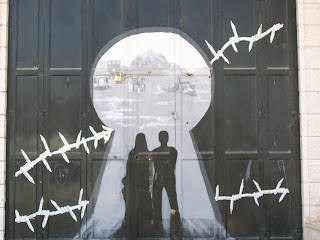
The key on the top of the entrance represents the refugees keys to their homes which they took with them when they were expelled.


This is some wall art near the camp entrance, again showing the symbolic importance of the keys which the refugees keep with them to this day, in the hope they will gain their internationally recognised right to return.

Sunday, 4 April 2010

Last lessons at the UNRWA school

Some students from the UNRWA school in Abu-Dis

Yesterday i did my last lessons at the United Nations Relief and Works Agency (UNRWA) school in Abu-Dis.

It's been great working with the teachers and students there and it was a nice last day, albeit tinged with sadness, with lots of smiles, handshakes and nice words exchanged.

But after i left the warm feeling was replaced by one of anger. Anger that these children have been completely failed by the British government, and the governments of the world, who have allowed Israel to get away with building a monstrous, illegal wall through their land.

Many children at the UNRWA school live near the eight meter high concrete wall. It dominates their view which was once hills and trees. What message does this send to a young person about their place in the world and the value of their human rights?

Many more of the children at the school are growing up in poverty because the wall cuts off Abu-Dis from the center of east Jerusalem, devastating the local economy.

The center of east Jerusalem is the place where Abu-Dis children would normally be going for educational, cultural and leisure activities. To pray at the Al-Aqsa mosque, see the historic old city, use the public facilities, and walk the bustling streets like Nablus Road and Salah Ed-Din street. Before the wall families could walk there in about half an hour from Abu-Dis. Now it is a dream for most people in Abu-dis, including the children.

It must be stated again and again that, according to any sense of natural justice, east Jerusalem is the rightful capital of Palestine. According to international law, any attempt by Israel to alter the final status of east Jerusalem, which the wall clearly does, is illegal. On every level the wall is an outrage.

The wall is also a problem for the world. After this precedent, which oppressive and power hungry regime will be next to build a similar wall - ghettoising a population it doesn't like and destroying their economic, political and cultural life?

At the time of writing, if you go to the Foreign and Commonwealth Office website you have to search a while to find out the UK government opinion on the wall. Higher visibility is given to the latest FCO campaign in Jerusalem, 'Speed sisters in the West Bank - the British consulate General in Jerusalem is running a campaign to encourage female participation in motor sports'.

I had a good time at the UNRWA school, but beneath the smiles of the teachers and students there is a lot of pain and sadness about what has been done to their homeland. I come away with anger at the injustice here and commitment to building solidarity with Palestine in the future.

In the next couple of weeks i will be visiting other places in the West Bank such as Hebron, Nablus and Jenin and hope to blog about my experiences there.

Wednesday, 31 March 2010

'Land day' facts

Yesterday was 'Land day' in Palestine, a day held every year to oppose Israel's seizure of Palestinian land and the demolition of Palestinian homes.

Here are some 'Land day' facts:

10% - The amount of the West Bank stolen by Israel when it built the separation wall.

103 - Palestinian homes demolished in east Jerusalem in 2009.

596 - Palestinians displaced due to house demolitions in east Jerusalem in 2009, including 281 children.

4,100 - Houses destroyed during the Israeli aggression against Gaza in December 2008.

500, 670 - The number of Israeli settlers in the West Bank, 17.2% of the West Bank population.

Source: Palestinian Central Bureau of Statistics press release, March 30th 2010.

"The most potent weapon in the hands of the oppressor is the mind of the oppressed"

Banner at the Al-Quds university graduation ceremony

Yesterday some of the students at Al-Quds university in Abu-Dis had their graduation ceremony.

The bitter reality for many graduates is that it is very hard to find decent work in Palestine. I have met people who graduated two or three years ago and are still looking for work.

It is not easy studying for a degree in Palestine. The checkpoints mean that many students leave their homes very early to reach their lectures on time, and even then they can be late if the soldiers decide to cause a problem. Some students have had their education disrupted by being imprisoned by Israel for engaging in legitimate activities against the occupation.

The lost culture of Jewish Arabs

Thanks to my friend Mohammad for introducing me to the Yemeni-Iraqi Jewish band Tzion Golan.

Click on this link to see a video clip of them performing.

The music and dress of the dancers are very similar to what we would associate with Arabic culture. You may also notice the similarity in the sound between the Hebrew singing and Arabic singing.

The video is a small reminder of what was lost when the state of Israel was created and the divisive ideology of Zionism became dominant - a historic and rich Arabic culture which was shared by both Jews and Muslims in Palestine, Iraq, Egypt and across the middle east.