Tuesday, 16 March 2010

Protests in Abu-Dis.....and in Shuafat, Essawiyya districts and Ramallah

The main road in Abu-Dis this morning.

The road outside the community center.

Two of my students make their way home with their children.

Weapons used on protesters today in Abu-Dis, probably manufactured in the USA. Metal balls encased in rubber, a rubber bullet and a live bullet.

Today Israeli soldiers clashed with protesters in Abu-Dis and other parts of East Jerusalem and the West Bank.

The trigger for the protests was the re-opening of the Hurva synagogue in East Jerusalem next to the Al-Aqsa mosque compound, one of the holiest sites in the world for Muslims.

The background to this is a sustained campaign by the Israeli government to remove Palestinians (most of whom are Muslim) from east Jerusalem. This involves forced evictions, house demolitions and the denial of basic municipal services to Palestinian districts. Then there is the separation wall which breaks east Jerusalem off from the West Bank.

I started my day like i do every Tuesday, going to the community center for my lesson with the university students. I had planned an exercise called 'My daily routine'.

About half way through the lesson the protests started. One of the students had just said, "I had cornflakes for breakfast today" when there was a loud bang outside. A student calmly informed me that it was the Israeli soldiers firing tear gas. I asked them if they wanted to continue and they said yes, "we are used to it". So we continued.

"I usually drink a mug of hot cocoa before i go to bed", said a student. Then there was another loud bang and a large group of young boys ran past the window. "The soldiers are coming past the center", somebody told me. We continued, a student said, "I usually listen to relaxing music in the bath". More bangs from outside.

My next lesson was with a group of local women, aged between 30-50. One of the women arrived and told us she had just been pushed by a soldier. She said, "He told me to go home and i told him, 'don't you dare touch me, i am going to my lesson!', i shouted to the boys in the street, 'may God be with you!'"

We finished early because one of the women had her children with her and they were frightened by the banging noises.

We walked past some of the protesters, all young men or boys, who had been throwing stones at the soldiers. They were nothing less than courteous. "Hi, where do you need to go?", "Come this way, it's safe", "Welcome to Abu-Dis". I bumped into a couple of my students from a local school, "Hi Jon, how are you? It's safe for you this way".

I got talking to some university students on the street. They took me through the backstreets to a place where we could observe the soldiers from a safe distance. We watched as the soldiers spread out across the road and started the descent down the road to where the protesters were. I heard later of two protesters injured by rubber bullets.

The students then invited me to their house for coffee. We discussed Palestine, Barack Obama, and the British government. One of the students told me he was beaten for no reason by Israeli soldiers at a checkpoint, "I couldn't see for two days because my face was so swollen. After that, i was in a kind of blind rage". We then discussed music and a student showed me his dance moves. These are normal students living in an abnormal situation.

I went back to my flat. From my balcony i could see a helicopter in the distance hovering over the Al-Aqsa mosque.

What is called 'calm' in Palestine just means people submitting to intolerable conditions and the denial of basic human rights. Today people in Abu Dis and elsewhere said 'no' to this false 'peace'.

Only justice and freedom for Palestine can bring lasting peace.


Friday, 12 March 2010

'I love life on earth, among the pines and the fig trees, but I can't reach it...'

This picture shows how Israel's wall cuts off one of the most important hills in Abu-Dis. My friend told me that as a child he used to go there to fly kites and play with his friends. Now children don't really have anywhere to play except for the polluted streets.

Below is a small selection of the many images and messages which have been written on the wall in Abu-Dis.

Mahmoud Darwish - author of the title of this post.


Thursday, 11 March 2010

'Have a nice day!'

Yesterday I accompanied a family i have become friends with to east Jerusalem. This involved going through the Zaytoun checkpoint. This has turnstiles with thick iron bars and airport style security scanners. Israeli soldiers bark orders through a loudspeaker. They speak in Hebrew to the Palestinians, not Arabic.

If your identification papers are not in order, or if they take a disliking to you, you can be held for hours and even strip searched.

The latest technology is used, so Palestinians now place their hands on a special scanner in order to be identified. I met an old man who said he has problems with it because after a lifetime of manual work the marks on his hands have become worn away.

As someone with a British passport i got 'have a nice day!' from the loudspeaker. I didn't reply.

Under occupation, the development of basic infrastructure in Abu-Dis (roads, traffic systems, rubbish collection, housing) is continually frustrated, but no expense is spared for the upkeep and maintenance of the Zaytoun checkpoint.

This is what many Palestinian's have to experience in order to go where they have lived, worked and worshiped for generations. The family i was with were only permitted to go to east Jerusalem for a day because the mother had to have a health check up.

I accompanied the family to the hospital before we went for lunch in the old city. In the hospital we met an elderly women who had come for cancer treatment. She had been accompanied by her son but he was turned back at the checkpoint because of a mistake (not his fault) on the paperwork he had been issued with. She was now alone carrying her belongings.

In the evening me and another volunteer went for dinner at the house of a local woman who we are friends with. We were introduced to her family. Her father questioned me about Israel's war crimes in Gaza and the complicity of the British government. He told me that two of his daughters live on the other side of the separation wall and he cannot visit them.

One of our friends daughters sang us a beautiful song, and we looked out over the expansive view from the family home of the surrounding Palestinian towns and Israeli settlements. On the right was east Jerusalem and Abu Dis, on the left the ever growing settlement of Ma'ale Adumim, it's street lights glistening in the dark in neatly arranged rows like a suburb of the US.

A resident of Ma'ale Adumim consumes eight times more water than a resident of Abu Dis. The settlement controls the local water supply, meaning that in the height of summer Palestinian homes are sometimes cut off.

Monday, 8 March 2010

International Women's day in Ramallah

Today i went with around 30 women from Abu-Dis and Bethany to the International Women's day celebrations in Ramallah. Unfortunately the coach was late and by the time we got to Al-Manarah square the protest had ended.

This was disappointing but it was still an interesting day.

It brought home to me the continuing importance of women's liberation. One of the women who came to the protest from Abu-Dis was married when she was 15 years old. She has never had formal education, and looking after her six children is her full time job. Her husband was on the phone a couple of times today asking her why she had gone to Ramallah. From her everyday manner you wouldn't be able to guess at these difficulties.

For me this is why central to women's liberation has to be decent free childcare, social welfare and workers rights, so that all women, not just a privileged elite, can have the opportunity to pursue education, leisure, and not be trapped in exploitative relationships out of economic necessity. Of course the occupation here is a huge barrier to any of these things happening.

It made me wonder how many people marking International Women's day in Israel gave a thought for women in Palestine.

On the coach to Ramallah i sat next to a women who works for the General Palestine Federation of Trade Unions. She provided me with information about the landscape as we drove past.

She informed me that the main road from Abu-Dis to Ramallah would be closed off by Israel in the next three years, forcing Palestinians to use an alternative route to get to Ramallah and Jerusalem. This route is longer and more complex, and involves passing through one of the worst checkpoints, where Palestinians are processed like cattle through turnstiles and security gates.

She pointed out how the Israeli settlements were expanding as we went past, with the older settlement houses at the top of the hills and the visibly newer buildings spreading out down the sides. Each settlement taking more land, roads and resources for Israel and less for the Palestinians, making chances of a 'viable Palestinian state' even more remote.

In short, Israel is imprisoning a whole population, and trying to destroy their chances for a decent future.

But you can almost forget this when you are walking the streets of central Ramallah. Here you can visit shopping malls, dine in nice cafes and there is even a cocktail bar. There are no Israeli soldiers or symbols to be seen, and Palestinian police direct the traffic.

But, from what i saw on my way to Ramallah, this doesn't represent real liberation but is more like telling a prisoner, "you control everything here, except for the walls".

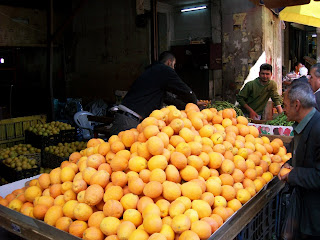
Ramallah market

I think Ramallah market beats Brixton market, but only just.

I think a small child got lost in here.

Lemons!

mmm......diabetes.


5 a day anyone?

Saturday, 6 March 2010

A wall for Palestine

In its cruelties, its injustices, its repetitiveness, and its gifts, there is nothing more exaggerated than reality.
John Berger

Yesterday the students at the UNRWA school in Abu-Dis showed me the wall display they have created which highlights significant moments in the history of Palestine.

These are early Jewish immigrants to Palestine. Generally they lived in peace alongside Arab Palestinians, which is why they are portrayed as happy and friendly.

This is Theodor Herzl, one of the founders of Zionism, who wrote in 1895, "We shall endeavour to expel the poor population [i.e. Arab Palestinians] across the border unnoticed, procuring employment for it in the transit countries, but denying it any employment in our own"

This is Lord Balfour, the British cabinet member who in 1917 promised support for a Zionist homeland in Palestine. This meant colonising and partitioning the land against the interests of the Arab majority.


This depicts the nakba (catastrophe) of 1948, when more than half of Palestine's native population were forcibly expelled, and half of Palestine's towns and villages completely destroyed. Upon this act of ethnic cleansing Israel was created.